
Why opening study isn’t making you better
The real purpose of the opening in chess

If memorising opening lines made you stronger, many club players would be masters.
You know the feeling: you’ve reviewed your lines from a Chessable course and you feel prepared.
Then your opponent plays a weird-looking move on move 3.
Suddenly you aren’t playing chess anymore. You’re trying to remember.
You search for a line that isn’t there, the clock keeps ticking and your confidence disappears.
For many players, that moment reveals something uncomfortable: their opening study has built dependence rather than skill.
The lie about openings
Most players think the goal of opening study is simple.
Find the best opening.
Memorise more than the opponent.
Get an advantage.
On paper, these all sound logical but they can all hold you back.
At lower levels, this often appears as opening traps: players memorise tricks that win quickly if the opponent cooperates. Sometimes it works and your rating goes up a bit.
But stronger opponents don’t fall for it. The game reaches a normal middlegame and suddenly you have no idea what to do.
At higher levels, the same pattern appears in a different form. Instead of traps, the focus shifts to blindly following what engines or courses recommend.
The underlying assumption is the same:
If I can reach a better position out of the opening, I’ll become stronger.
But chess doesn’t work like that.
You don’t become stronger when you reach better positions.
You become stronger when you can play better moves in more positions.
Every chess game eventually reaches a moment where neither player knows the next move from memory. Once you’re there, the position only cares about what you understand, not what you remember.
Grandmasters can squeeze tiny advantages from the opening because their fundamentals are already elite. That small edge actually converts.
Most players aren’t in that situation, so they end up overinvesting in the least important phase of the game for their improvement.
Sitting underneath all of this is fear.
The fear of getting crushed in ten moves.
The fear of being embarrassed.
Memorisation feels like control but if your confidence disappears the moment someone deviates, that control isn’t real.
What the opening is actually for
When you zoom out, the opening has a much simpler job.
Its purpose is to lead you to middlegames where you can think and learn.
That’s it, because you can improve from doing those two things.
The opening is a gateway. A good opening gives you positions where you can apply chess principles: central control, piece quality and coordination, king safety and planning.
When you start viewing openings this way, something changes. Instead of searching for the perfect line, you start paying attention to each position. Instead of asking “what move does the engine recommend here?”, you start asking “why is this move popular?”
The opening stops being a test of memory and becomes a training ground.
It took me years to realise this.
Even masters fall into this trap
In the year I became an International Master, I made the Australian team for the Olympiad.
In the lead-up to the event, the other masters on the team gave presentations on openings they specialised in.
I was the only one who didn’t.
I’d played a thousand tournament games but I struggled to explain positions clearly. I was playing from experience and feeling without deeply understanding each move.
Years later, after my rating had crossed 2450 I convinced myself that openings was my weakness I should focus on.
So I did what many ambitious players do: I bought opening courses, reviewed lines obsessively and treated memorisation like serious work.
It felt productive, but over the next couple of years I dropped around one hundred rating points.
The problem was how I was using the courses: I was building memory instead of understanding.
In one game against a grandmaster, I reached the end of a prepared line and realised I didn’t understand the position at all.
That was the moment it clicked.
Following someone else’s moves doesn’t help you get better at playing chess. If you can’t explain a move in your repertoire in your own words, that’ll come back to bite you one day.
Shu, Ha and Ri
A concept from Japanese martial arts describes the ideal learning process beautifully.
It’s called Shu–Ha–Ri (守破離), the three stages of mastery.
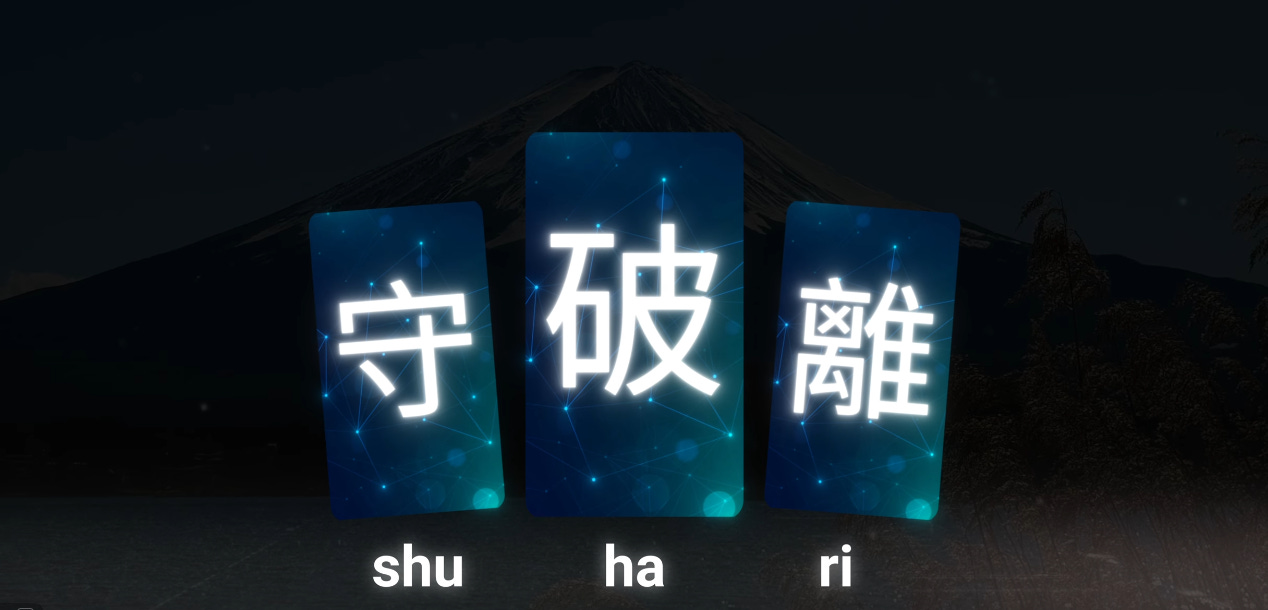
In Shu, you follow the form. You copy the techniques exactly as they are taught.
In Ha, you start to question and break the form. You experiment, try different ideas in each game and start building your own understanding.
In Ri, you transcend the form. The plans and principles become internalised and you develop your own style or way of play.
Many chess players remain stuck in the first stage, copying moves without digesting them.
They might know what move to play, but not why.
Real improvement begins when you move beyond that stage and start explaining moves and positions to yourself in your own words.
What opening study should actually look like
Openings should only occupy a small part of your time on chess.
The majority of improvement comes from playing games, analysing and learning from them, solving and studying other players’ games.
And you should build your understanding from the why behind each move, not just what move to play.
A healthier approach might look like this:
Play serious games (classical or rapid, focused)
In reviewing it, find where you want to play another move next time based on how that game went. You can see what other players have played in the Lichess databases at the master level and around your level
Write notes in your own words about what you learnt from the game and what you want to try next time
Study a few games where they played the move you want to try next time.
Over time you begin to recognise patterns: where pieces belong, what plans both sides typically go for, what pawn breaks come up.
Then, moves stop being fragments you’re trying to recall.
They become ideas you understand.
The real goal
The point of opening study, as with any other area, is to get better at chess.
If you treat your openings as a living part of your training, every game adds something to your understanding. Each new variation becomes another branch on a tree you’re growing.
You’re not searching for the perfect opening.
You’re cultivating a training ground that grows with you.

If you’d like to to also watch a video on this topic, here I explained how opening study should change at different rating levels:
I’m curious about your experience with openings, because we all tend to have some sort of history when it comes to our relationship with them.
What part of opening study do you struggle with the most: understanding the moves, forgetting the lines or spending too much on it compared to other parts of your chess?
Even when one is no longer attached to things, it's still something to have been attached to them; because it was always for reasons which other people didn't grasp. The memory of those feelings is something that's to be found only in ourselves; we must go back into ourselves to look at it.
—Marcel Proust, Sodom and Gomorrah (In Search of Lost Time #4)
This is going to sound a little ridiculous in the age of Chessable, but these days I often try to avoid memorizing opening lines in favor of learning where the pieces usually end up, the typical pawn structures and breaks, that sort of thing. That way I'm thinking on my own as early as possible, but I have the confidence that I'm not going to do anything crazy because I know the underlying principles.
The only time I really try to memorize a line is if it's so sharp that a deviation is fatal - and in those cases, I often try to avoid the line in the first place.
https://thebluearmchair.substack.com/p/a-little-local-difficulty?r=5kmhkr