

“When in doubt, choose more interesting move.”
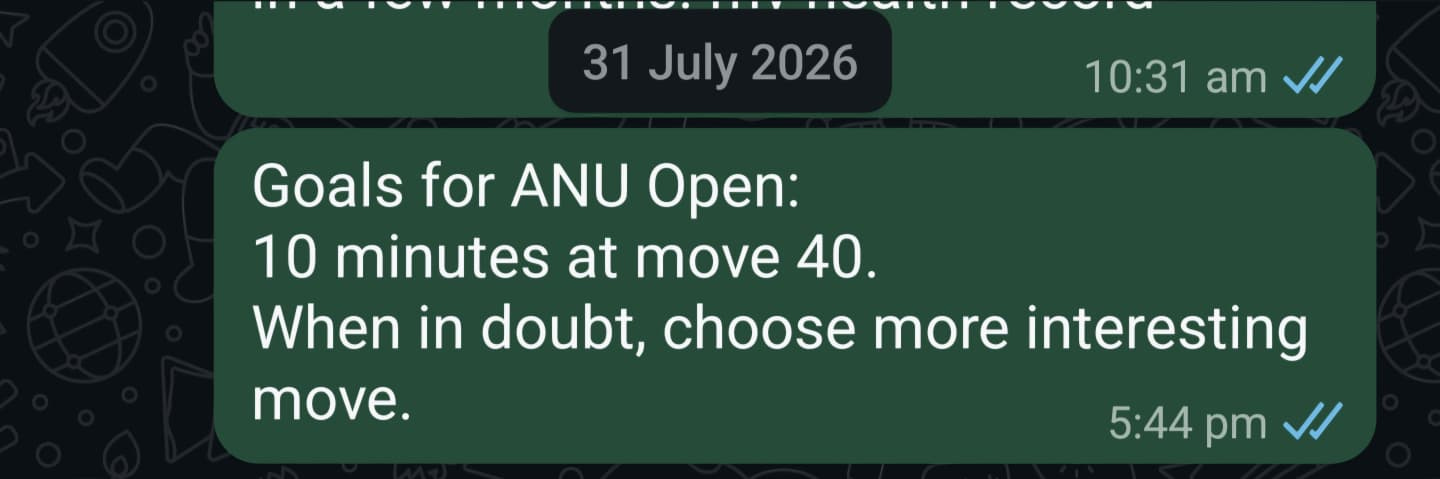
This was my second goal in my recent tournament (I wrote about the first goal last week:

Does the statement make sense to you? No? I must admit, it sounds pretty vague. But it is extremely clear to me what I mean, so let me break it down because it might be something that could help your chess.
What is an interesting move?
If I have more than one option I can play and I’m not sure which one I should go with, I try to choose the one that leads to:
variations or positions that I feel excited about, curious about or scared to go into
typically, more open-ended, flexible or dynamic positions
as opposed to the options that:
limit possibilities/options for both sides
are too passive
go to the kinds of variations or positions I’ve already played a lot
I don’t feel excited by
I don’t feel curious about what it would be like to play it.
So it’s a combination of the kinds of moves and positions I want to play and those that I want to avoid. Of course, the options also have to be good enough quality-wise, but a lot of it comes from choosing moves and directions that help you learn more.

Why play interesting moves?
I’ve often talked about the importance of having goals that are separate from results. Personally, having this goal of playing interesting moves makes it easier for me to play the kind of chess that will help me learn and grow, compared to playing say the same old opening and structures I’ve played for decades where I might feel comfortable but I won’t really learn anything new.
At this point in my chess life, where I’m not 100% focused on being a player but I am still working on long-term improvement, I’m focusing on my weaknesses more than my strengths. That includes facing positions or structures I would have tended to avoid in the past due to fear, uncertainty and wanting to stay in my comfort zone. You might be at a stage where you want to repeat and deepen particular variations instead.
Most of us have a picture of ourselves as a chessplayer: a style or persona, and while this can help us be confident in the areas we like and excel at, it too often makes us avoid others and makes us think we should avoid those since we aren’t good at them (and it is too hard to improve them). When you find a way to outgrow these oftentimes misplaced fears or avoidances (because I think a lot of dislikes and biases in chess comes down to simply not spending enough time or reps with it), we naturally expand our repertoire as a player in all parts of the game. Then, we feel more confident in a way that we naturally focus on learning and trying new things over rating or results.
I believe defining what interesting moves are for you helps with that mindset.
Interesting moves in practice
Ok, after these lofty abstractions, let me show you examples from my tournament.
Example 1
Playing as Black in Round 1, the opening moves were 1.Nf3 Nf6 2.g3 c5 3.Bg2 Nc6 4.O-O e5 5.d3 d5 6.e4.
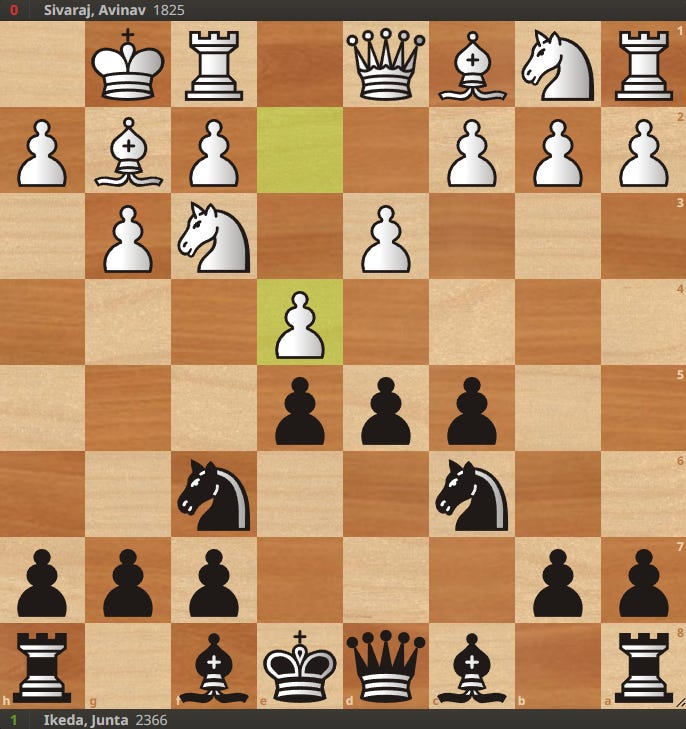
I’ve actually never played this exact position as Black OTB or online, just once as White online. I’d decided some time ago that here I’ll try 6…d4, a reversed Petrosian Variation of the KID, but a part of me was a little scared. “I’m more used to this kind of position as White…what’s my best move-order against 7.a4, setting up Na3? And how should I answer 7.Nh4 with a quick f4, since I’ve released pressure on e4?”
I didn’t know, but I still played 6…d4 quickly, because I knew that this wasn’t the move to hesitate on. Whatever, I’ll work it out, I know playing 6…d4 is fine. You might laugh, but in the past I might have spent ages here trying to work everything out. So even a normal-looking opening move like 6…d4 is an interesting move for me because I’m actively choosing unfamiliar positions, knowing I’ll learn things through playing.
A few moves later, after 7.a4 Be7 8.Na3 Be6 9.Nc4 Nd7 10.Ne1:
Example 2
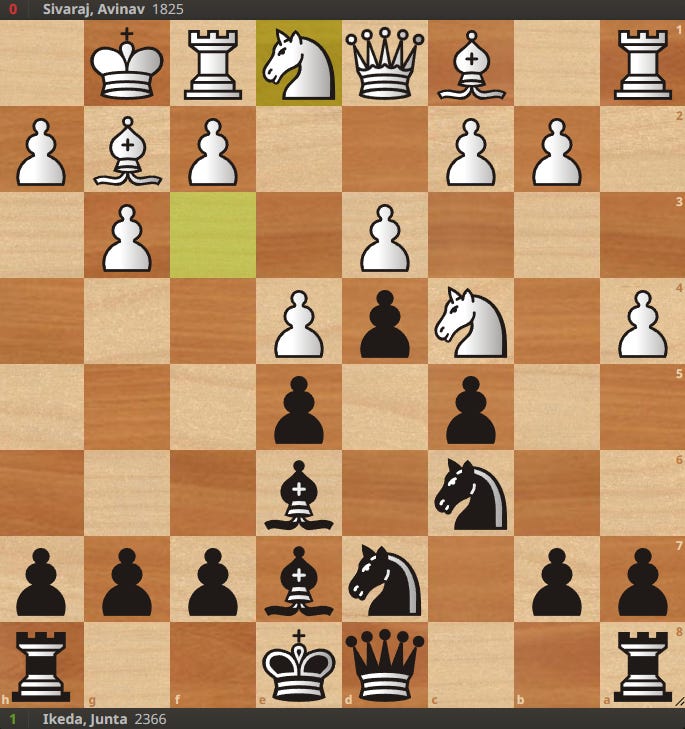
f4 is coming (and then perhaps Nf3), what to do? I thought about 10…g5 but wasn’t sure if I liked how things look after 11.f4. Then I thought of 10…h5 which looked the most interesting - if 11.f4 I play 11…h4 and maybe White is the one who will have have to worry about their kingside in the middlegame. I wasn’t sure how the game would go after 11.h4 or 11.f4 exactly so I spent 9 minutes here (too long!) but I realised I have to play it - it’s the move I’m excited and curious about and also a little scared of!
Again, instead of trying to calculate out un-calculatable positions, triple-checking and hesitating like I used to, noticing how I feel about particular moves has let me just go with my gut more, which is good for me as an intuitive-but-cautious kind of player.
Example 3
In Round 3 as Black, believe it or not, I already played an interesting move after 1.e4 c5 2.Nf3, which was 2…Nc6 (?!). The Kan with 2…e6 3.d4 cxd4 4.Nxd4 a6 has been my main opening since 2004, and even in my tournament in April this year, I ended up just playing that in 3 games but suffering. I’ve been thinking I need to let go of it for good for some years to play new things and expand my chess. So 2…Nc6 was meaningful because I’m practicing new things rather than sticking to the old ways.
After 3.d4 cxd4 4.Nxd4 I played the Godiva Variation, 4…Qb6, and after 5.Nb3 Nf6 6.Bd3 e6 7.O-O Be7 8.Qe2:
Example 4
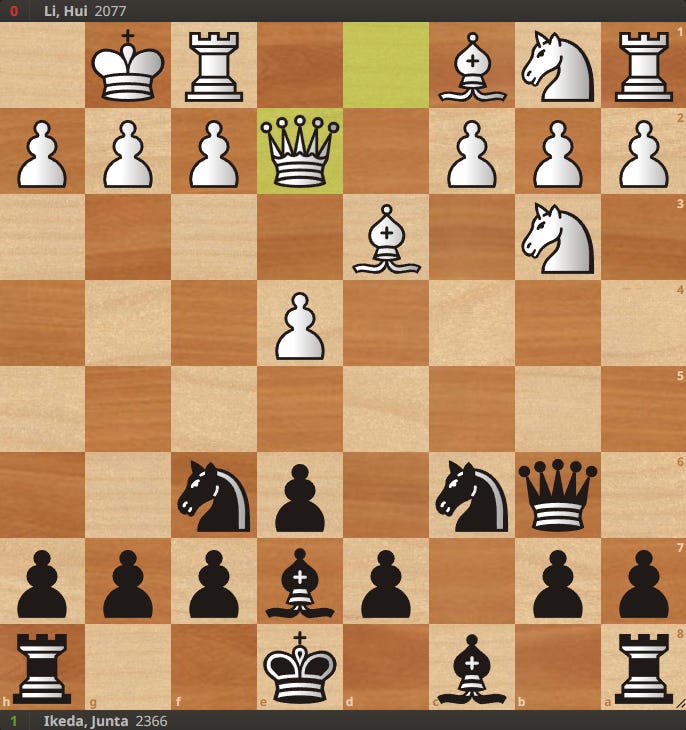
After a lifetime of playing the Kan and Hedgehog structure, my instinct here is to play 8…d6. But again, that would be like playing the Kan. So, new pastures: I played 8…d5.
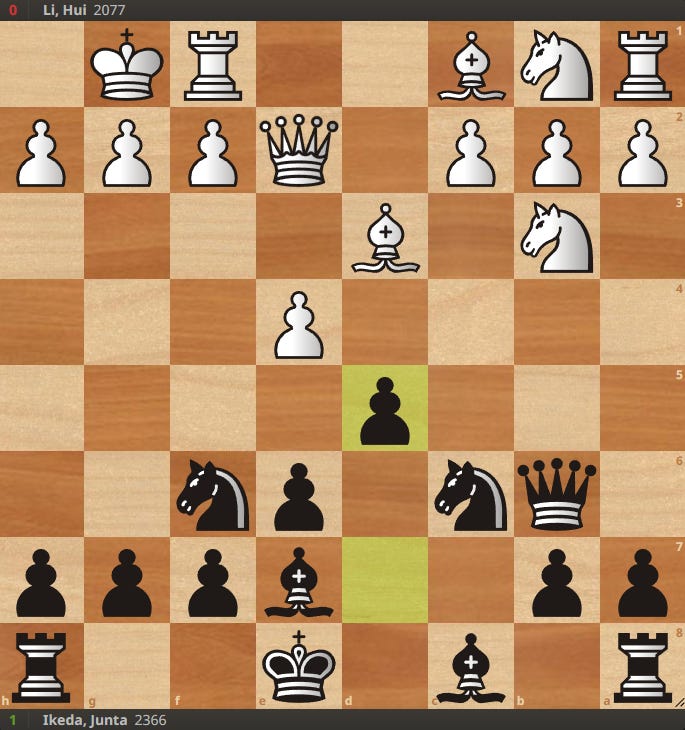
If White plays 9.e5, then the game could go 9…Nd7 10.Be3 Qc7 11.f4, a very French-like structure. Probably objectively speaking White is happy there, but that would be the kind of position I haven’t played much and looks super interesting. Gotta play it.
White’s choice in the game, 9.exd5 was also strong. If 9…Nxd5, I felt it would be too easy for White to develop comfortably with moves like c4, Nc3 and Be3/Bf4, so I took back with the pawn.
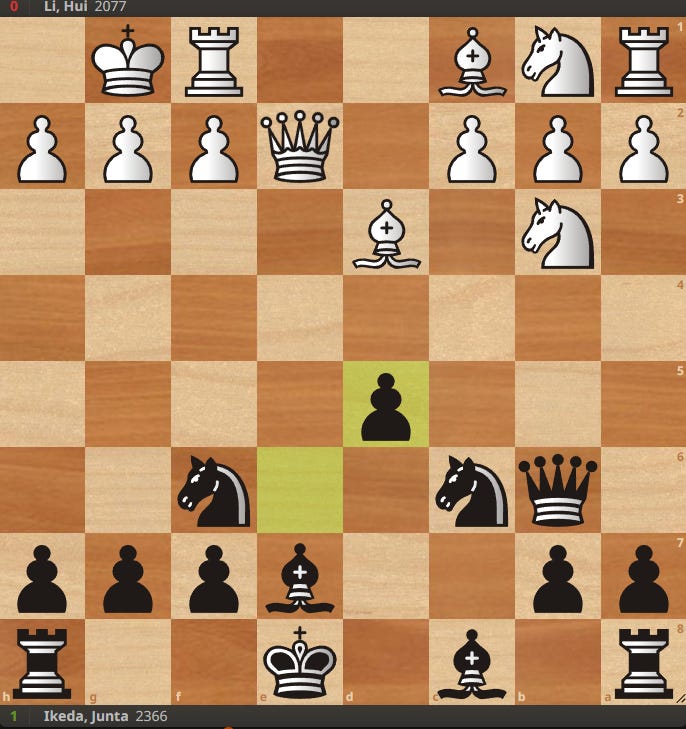
White does have an annoying continuation, as my opponent played - 10.Be3, and somehow I didn’t like the look of 10…d4 when the pawn on d4 might not be bad, but it seemed easy for White to play the middlegame: Bg5, N1d2, rook to e-file. So I played 10…Qc7, but this does allow 11.Bc5, after which the game went 11…O-O 12.Bxe7 Nxe7.
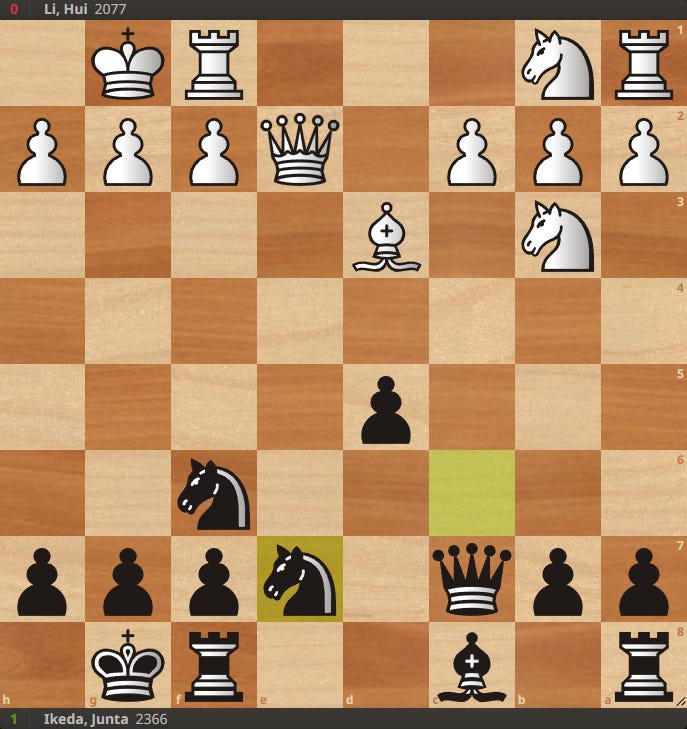
Black has an IQP, White has managed to exchange Black’s good bishop already, and d4 can be secured for eternity with c2-c3. But I felt that Black has enough activity (after …Ng6, …Re8 etc.) to compensate, and it was a little scary because if I can’t get enough play going, statically I’m just worse for the whole game but I wanted to test my judgment.
So for me, looking for or prioritising interesting moves helps me choose the scarier move in games that I’m curious about and can learn from, and just feel excited about. For you, the conditions for an interesting move might be different.
Would love to hear whether you use this kind of thinking, or what interesting moves would be in your chess.
Where love is great, the littlest doubts are fear,
Where little fears grow great, great love grows there.
—William Shakespeare, Hamlet (Act III, Scene II)
The 10-Habit Chess Improvement System
If you’re new here, one of the habits in my course teaches you how to build confidence in your own chess like this by facing your fears and prioritising learning. Built for players who want to improve the quality of the time they spend on chess.
I strongly agree with the idea of always playing the most interesting move. For me, the most interesting moves are the ones most people would consider boring. I am often too ready to throw caution to the winds and mix it up, so I've been working on playing more simply, not trying to force things, and learning how to play more positionally.